|
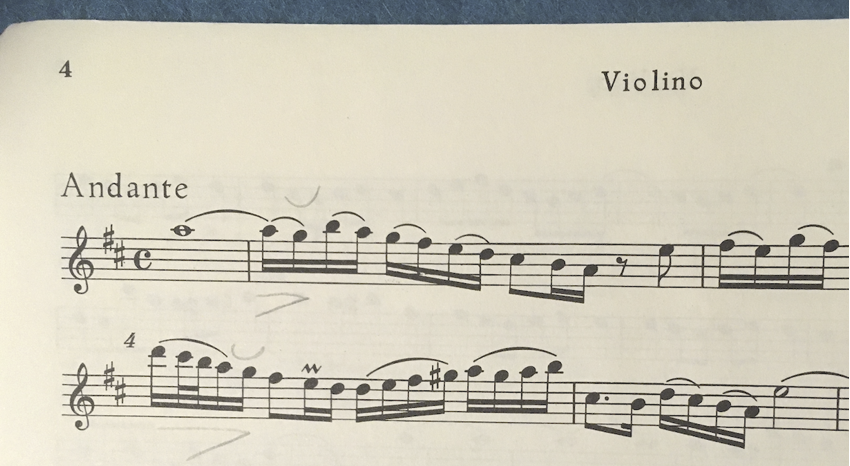
Here's a screenshot from my last workshop where I was explaining one of my favorite passages in the Corelli Allegro. The key here is not to gloss over the 16th notes with a fast tempo, but take the moment to have fun with sculpting the notes with varied articulation.
In this particular passage, we see two different types of passages. In the first line last bar and ongoing, the 16ths indicate a passage where we're moving by harmony and not by melody. In this case, we'll want to use a gentle "tu-ru" and not clipping the notes too short. This is to create an acoustical effect which imitates the arpeggiation on a violin and is most suitable here. We want to refrain from focusing on individual notes, but rather on the movement in harmony which requires focusing on groups of notes. In the last two bars of the second line, I show how the pattern suddenly breaks up with the leap up to G2 and then something new starts. Here, we can create a sense of swing in this gesture by clipping the G2 short, almost dotting it before going on to the rest. In the last bar, try to accentuate slightly on the little off-beat notes to further create a cheeky, playful gesture. (g C# d / F# e / D c# / E d). Here, you'll want to clip the last note of each group. With practice, it is possible to create this space and expression even within a fast tempo. However, our intention needs to be discovering and creating these fun gestures and not aiming for speed. Speed is only one of many tools in the service of expression! In this way, it makes playing fun for YOU as the player.
0 Comments
Meter, phrasing, and harmony are some of the possible factors that determine a note's length. Remember that notation is really a very limited way of suggesting how the music should actually sound. Beyond any rules or historical knowledge, I feel the best piece of advice I can give is to always think about what kind of AFFECT, what expression do you want to achieve with a piece of music. And then everything you do is to serve that expression.
So for example, in the above Andersen etude I wanted to show something joyful, light, moving, something bouncing between the ground and the sky. So my point was to utilize different types of short articulation to create those effects and affects. You won't get this idea by simply looking at the sheet music and it would be almost impossible to notate every nuance. And since articulation is always in connection with how you manage your air, both the tongue and the breath give each note a definitive shape, length, and timbre. So always listen and observe carefully whether the tongue and the breath are really coordinating together to achieve one goal, one expression, or whether they're a little out of sync with each other. Coming back to notation, if we accept that notation is only a rough way of suggesting how a piece of music should basically go, then it's not far from understanding inégalité. The subject is complex but I want to mention one instance in regard to this topic. You see above a typical cadence (from Boismortier's Op. 35, E minor suite). After the cadential trill, the first G we play is known as an anticipation. As the name suggests, it anticipates the final note and thus should go towards it. Don't be influenced by the notation in thinking that you must play a proper 8th note, or think because baroque music has such an emphasis on articulation that we have to make that separation of the two G's distinctly. Also, even if you claim to not speak French, you probably know a bit more than you actually think you do. Think of words like "amour", "café", "merci" - or look them up in YouTube or any pronunciation site. Notice how in these words the first syllable also slides smoothly towards the second syllable. That's how we should play such a cadential pattern. This is also why using the tonguing pattern "TU-RU" is extremely helpful and, ultimately, natural. Compare by playing it with two equal tongue strokes and you'll notice the difference. Compare also if you would try to "soften" the 8th note but still playing with two equal tongue strokes, you may even find your tongue nevertheless naturally wanting to retract to create an alternation in the tonguing. And one last thing but crucial in this formula, be sure to diminuendo, lighten up the breath as you play the "TU-RU" into the cadence. Notice in the French words mentioned above, they all sound somewhat open-ended. We don't have a definitive "stop" to the sound. Many French words act this way, even if there are letters at the end. (think of the composer's name "Blavet", "croissant", "toujours"...). The diminuendo we do is in response to creating and imitating that subtlety. Try this out and let me know what you find! These are passages from J.S. Bach's St. John Passion. We often have to play in flat keys in this piece, and should you have problems with the high Bb that it's too sharp, especially when you want to accent it, try using a kind of tonguing that's further back in the mouth to minimize the "explosion". Use a "D" and experiment with how far back you'd tongue and compare the effects. Also, a very slight nudge or "pump" of air would suffice and imagine using "warm" air rather than just sheer blowing "cold" air (the point is to decrease unnecessary pressure). There's no need to make this huge and it's more fun to be in tune with your oboe colleague.👌
Another option might be even using A#, which will be lower in pitch. It'll probably be less useful here, but keep it in mind in other places and find out what works for YOU. Everyone and every flute is different, but knowing your options and finding your solutions is what makes baroque flute playing so exciting!🥳 I recorded the air "C'est bien a tort" by Bacilly as demonstration material for a learner of mine. In the recording, I caught myself in a passage which I think would be interesting to talk about. And in case you're wondering, the upper line is in soprano clef, which is like reading G clef a third lower. So where the red asterisk is, we have a trill on a C (also marked with x), and the note before the trill is a D. We have here a situation where the note before a trill is the same as the appoggiatura of the trill. This often creates a bit of confusion and we easily lose clarity between the notes (in this case two D's). The goal is to still have a distinction between these notes, however subtle that distinction should be. The trill falls on the "ssens" of the word "ressens" and we'd want to reflect that fine nuance of the "ss". We can achieve this by gently ending the sound of the first D with the tongue, and then making sure to start the trill with the appoggiatura. Bring the tongue back up to the roof of the mouth, right about behind the front teeth. This will make the tongue end the first D and also be ready to start the appoggiatura D. You should feel a slight resistance on the tip of the tongue right before you start the next note. This refined coordination also needs a fraction of time to make sure the D appoggiatura really sounds and doesn't get swallowed, otherwise the trill would then become like a mordent or something. That's what happened in my initial recording, and when you're familiar with the style and expression, it sounds a bit out of place. I want to point out that this is not just a dogmatic following of the principle that we should start trills on the upper note, but there are musical reasons for doing so. With a quick and light appoggiatura, the trill here should sound like a slight tremble in the voice, or simply a flutter in the air. The two D's also make the line very smooth, which makes sense here for the expression. In addition, immediately retract the breath after the appoggiatura to further enhance that wistful affect. Compare if you'd play something like C-D-C on the C as the ornament (so omitting the appoggiatura) - I find it takes away from the "leaning" effect of the appoggiatura, which then also reduces the tender, yearnful expression here. Don't forget that, beyond vocal airs, we can make the same observations in numerous instrumental music. In fact, French flutists were first playing these airs de cour before specific flute music came into existence, as well as the common ideal for any instrumentalist was the human voice. So certainly in lyrical pieces, their playing would reflect a strong vocal tradition. The expression of ornamentation is also one of the hallmarks of baroque music. The very fine details convey expression and thus require a specific way of execution. There are usually a good number of clues in the music to help us decide on our interpretation, and what we know as "rules" have certainly musical reasons, not just theoretical ones. Below is my demonstration video: So after my last post talking about Wilbert Hazelzet's idea of "don't play", I thought to follow up with this list of common issues we encounter when playing the baroque flute. Just off the top of my head, these are movements or tendencies that are unnecessary and prevent us from playing in an efficient way. The more we can reduce, the easier and more enjoyable playing becomes. Go through this checklist as you play - maybe you'll discover more and I'd love to hear from you!
✅ 1. The baroque flute takes less air and slower air compared to the modern flute. ✅ 2. When moving upwards to the mid and higher register, keep using the slowest air possible and avoid overshooting. ✅ 3. You can influence intonation by adjusting angle of air and/or the airspeed. Sometimes you'll need to do both, but sometimes adjusting air speed is enough and also a better choice than adjusting angle. Adjusting air speed is the more subtle way and there are times when that's all you'd need. ✅ 4. Lips should remain stable when doing staccato or accents. Refrain from air kissing! ✅ 5. In an ensemble (starting with a duo), you'll often have plenty of time to prepare yourself for an upcoming passage. Take advantage of that. You have to check your air, lips, tongue, and also maybe cueing in your fellow musician(s) - that's A LOT that needs to happen! Is it a high note that needs to be soft? Is it a note like F natural or Gb that requires attention in terms of intonation and/or focus? Start taking in air way in advance and don't wait until right before you play to breathe. You can still take a kind of small, "symbolic" inhale to help you be in the movement of your cue (or even none at all but just cue with your flute), but keep your movement simple and precise. ✅ 6. Avoid breathing right before your entry with your mouth open. Breathe through your nose so that your embouchure is ready for the coming passage. ✅ 7. Watch out if you're approaching a rather high note, say like F#3 or G3 (or any note that feels unfamiliar to you) to not tense up in the body and literally "shrink" with your flute. Instead stand steady and tall, imagine to release the sound from your hands rather than clamping down on the flute. ✅ 8. Watch out to not squeeze with your lips to produce high notes. If you're feeling tension in the lips for high notes (signs include when you feel the outer edge of your lips, or when they tremble or produce buzzing), that means they're not quite strong enough yet to handle the slightly faster airstream needed. ✅ 9. We achieve brilliance and strength with forked fingering notes like F natural, G#, Bb etc. by being able to play them with a focused tone and in tune. They don't gain strength by us blowing more (too much too fast air), although it's very easy to do so, especially due to stress. ✅ 10. Tonguing is more about precision than tonguing hard. Use less tongue surface but back the note with air to create accentuations when needed. ✅ 11. Explore more the softer dynamics, creating more diminuendo/lightening effects to create contrast. The baroque flute is not known as a loud instrument, but you'll have much more success in creating a rich dynamic range by widening your middle to soft dynamics. And in this way, a beautiful resonance is achieved which shows off the instrument at its best. Less is more, achieve the maximum with the minimum. |
ABOUT THE BLOG:I got inspired to document my own observations in flute-playing and music-making. Also, I thought it's important to pass on the teachings of the great Wilbert Hazelzet, as well as many other mentors who have influenced my artistic visions one way or the other. Enjoy this potpourri of tips, inspirations, and musings. ✨CONTRIBUTE!✨Yes I love the writing that I do! If you love them as well, how about consider showing your appreciation with a personal contribution? TOPICS:
|


RSS Feed